Saturday, October 15, 2011

Out For a Walk


Jeff, Alexa, and I just returned home from my first real foray into the streets of Cambodia. I walked down to the convenience store yesterday—a story in itself—but that doesn’t really count because it’s only two or three doors down. This afternoon we went for a real walk.

We had two main goals for this expedition: locate the interdenominational English-language church that, according to its address, is nearby; and get lunch. We left our house around noon, planning to find a restaurant on the way to the church.
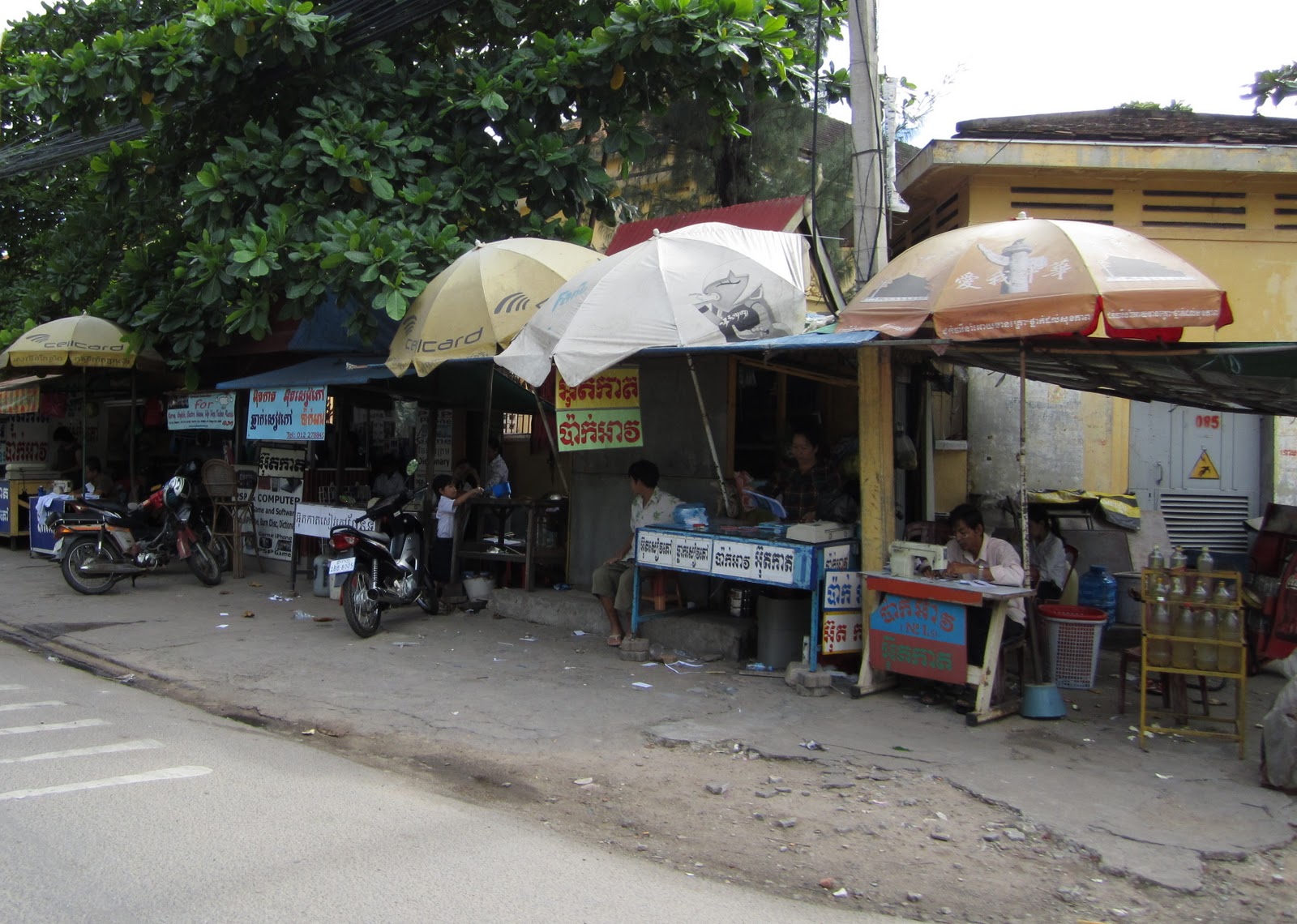
Along one of the larger streets

We walked a few blocks before we started seeing anything that looked like restaurants. The first one I spotted … well, we aren’t certain whether it was a restaurant or a produce shop. The name and the pictures outside could work for either one. We decided to skip it; even if it was a restaurant, it looked like a salad place, and that isn’t really what we had in mind today.

We stopped at the second restaurant we saw. I don’t recall the name of the place, but it was nice. From the outside, it was clear that it catered to westerners. We had to cross the street to get to it, and one of the employees ran out into the street with a sign to stop the cars (it wasn’t necessary, but it was a nice touch). Another employee opened the door, and a third led us to a table and presented us with menus. Jeff and I ordered sandwiches, and we ordered chicken kebabs for Alexa. Everything was tasty and reasonably priced, and Jeff particularly appreciated the free wifi, which he was able to use with his phone.

Motos
After lunch, we continued on our way to the church, which we found with no problem. On the way, I tried to take in the atmosphere of Phnom Penh. In many ways, it reminded me of Maadi, the wealthy Cairo suburb where we lived until earlier this year. There was trash on the streets, though nowhere near as much as in Egypt. In places, there was a decidedly unpleasant aroma of unknown origin that reminded me of the worst air quality days in Egypt—although it couldn’t have been from the same cause, as it wasn’t all over here and there isn’t anywhere near as much pollution. There were lots of trees, broken sidewalks, and rough roads, just like in Maadi. I even saw one building where I recognized the squiggly lines as Arabic calligraphy rather than the Khmer script that adorns most buildings and signs. Egyptian taxi drivers trying to get our attention were replaced by Cambodian tuk-tuk drivers, who smiled more and acted friendlier than their Egyptian counterparts.

Pretty balconies on a Phnom Penh building
Phnom Penh is different from Cairo in many ways, aside from tuk-tuks and their friendly drivers. The architecture is different, though still foreign, and some of it is beautiful to my American eyes. Traffic was very light, presumably because it’s a weekend. The only time traffic was ever that light in Egypt was on Friday morning. There are traffic lights at the major intersections here, rather than police directing traffic. For the most part, drivers even obey the lights—they fudge some when the counters near zero, indicating that the light is about to change, but overall, they stop when it’s red and go when it’s green. I noticed on Thursday that even during the week, the traffic is nowhere near as heavy as it was in Egypt. Those are the obvious differences that I’ve noticed so far. I’m sure there are others that will become apparent later.

But now it’s time to be off. We’re going to the supermarket to stock up on groceries.


Written Saturday, 8 October 2011.

Friday, October 14, 2011

Traveling to Cambodia

Phnom Penh airport. Photo obtained from Wikimedia Commons. Author: Chikumaya

We’ve arrived in Cambodia! After three months in the States, delay after delay in the paperwork, problem after problem with our shipment, we finally arrived in Phnom Penh two days ago. We arrived on Thursday, 6 October, and it now is Saturday, 8 October … although there’s no telling what day it will be by the time this post is published. We don’t have internet yet, so I’m typing and saving and assuming that I’ll be able to get online from the embassy sometime next week, or even that we’ll have our own internet up and running within the week.

The trip was long, but not as painful as I expected. We took 4 flights, with a total flight time of around 25 hours and an additional 17 hours or so waiting in airports (or at the hotel within the airport complex, in the case of the 8-hour “overnight” in Bangkok). We’ve been blessed to have earned a ridiculous number of frequent flyer miles on United, which turned out to be the only—yes, the only—airline that met our travel requirements, so we were able to upgrade from economy to business class for the two longest flights (11 and 7 hours). Business class on those flights made all the difference in our travel experience. We were able to put our feet up, and despite some mechanical problems with my seat, we were able to recline far enough to sleep in relative comfort. Even Alexa got in on the act, as we took her out of her carseat so that she could lie on her daddy’s chest for a while and sleep more comfortably.

So why did we fly United, even though Delta holds the contract for U. S. government travel between Washington, DC, and Phnom Penh? Two reasons. Their names are Cleo and Isis. It was much more difficult than we ever anticipated to arrange to fly two cats as accompanied excess baggage. On the way back from Egypt, we took them in the cabin with us and had no problems … but we were able to do that only because we hired a pet expeditor, who was able to “convince” the airline representatives that they were within the in-cabin weight restrictions. We’ve been told that the airlines in Asia actually weigh the cats, and they are strict in their adherence to the rules. And, well, our cats are fat. Isis weighs approximately three times the upper limit for in-cabin travel, and Cleo is barely above the limit. People here at post told us not to ship the cats as unaccompanied baggage, or we’d have to wait weeks for them to clear customs. That left accompanied baggage. I don’t think Delta actually had a problem with that; the problem was with the regional carrier affiliated with Delta here in southeast Asia. They wouldn’t allow us to bring both cats, or maybe they wouldn’t allow us to bring either cat. I don’t remember, as Jeff is the one who did all the research. But it turns out that Thai Air, affiliated with United, had no problems taking our two fat cats as accompanied baggage. We did end up taking one “extra” flight, though, because United only allows one pet on its DC to Tokyo run. We ended up flying from Baltimore to San Francisco, and then on to Tokyo. From there, we flew to Bangkok, then on to Phnom Penh.

In Bangkok, we had maybe 45 minutes of worry that we wouldn’t be able to continue to Phnom Penh. We had made all the necessary arrangements for the cats, including paying United the associated fees. But Jeff is paranoid, so when we arrived in Bangkok, before we went to the hotel, he checked with the Thai Air representatives to make sure everything was okay. Yes, sir, everything’s fine, just check in before your flight and don’t worry about a thing. Uh huh, right.

It turns out that we had paid United their fees, both for the cats and for the extra bag we brought, but United had not charged us the fees for Thai. It took 45 minutes, three desks, three customer service representatives, and two supervisors to figure out the problem and rectify it. To be fair, though, the first customer service representative was excellent, as she consulted with the others and with her supervisors, and then personally escorted Jeff to the second desk and all of us to the third. She was full of apologies and was careful to make it clear that she realized that we’d done nothing wrong and that none of this hoopla was our fault. We, in turn, tried to make it clear that we realized that she’d done nothing wrong, that Thai had done nothing wrong, and that this hoopla was not their fault, either. So I guess we all decided to lay the blame at the feet of United, who was not there to be offended. I’m not sure if the problem really was that United was supposed to collect all the fees and distribute Thai’s to them, or if the Thai representative from the night before should have realized and told Jeff that there would be additional fees to pay. In any case, it all worked out and we arrived at our gate mere minutes before boarding began. I even had time for a quick trip to the restroom.

From there, it didn’t take long. The flight to Phnom Penh was a little less than an hour. In that time, the flight attendants managed to offer us breakfast and countless cups of tea or coffee. They even provided jars of baby food for Alexa. Luckily, she slept the whole way, so the flight attendants didn't see that she would have rejected their generosity in favor of our grown-up food. Since we've been here, I've noticed that Cambodian servers in restaurants have seemed surprised when we order regular food for Alexa and then even more surprised when she eats it, so I do wonder if it's a cultural thing that toddlers her age still eat baby food here.

I’m not sure if the airport here in Phnom Penh is very small or just very efficiently laid out, but it took us only a few moments to walk from our gate to immigration. A Cambodian man from the embassy met us and helped us to claim our luggage—seven 70-lb bags, a stroller, and two cats, both still alive and meowing furiously—and walk through customs. Our sponsor met us outside and we caravanned in two SUVs to our new home. I didn’t look around as much as I thought I would during the drive; I was too busy chatting with and getting to know our sponsor. My first impressions, though, were positive. There was lots of greenery, interesting and at times beautiful architecture, and traffic that was unruly by American standards but tame by Egyptian ones. I look forward to getting to know the city better in the days, weeks, and months ahead.

We received a pleasant surprise during our drive—our sponsor informed us that our permanent quarters were ready for us. We’d been told previously that we would be in temporary housing until mid-November, as the previous occupant of our house had been asked to stay until mid-October, and then a month would be required for the make-ready. I’m not sure how the quarters were vacated and made ready for us so early, although I assume that the previous occupant didn’t extend his time here after all, but I’m grateful. There are only two downsides to moving directly in here, both very minor: we don’t have immediate internet access as we would have in the hotel, and we are not being forced to become familiar with another area of the city just yet. I’ll gladly accept the delay in internet service and the fact that I must motivate myself—rather than being motivated by where I live—to become familiar with different areas of the city in exchange for knowing that we’re finally home, we don’t have to be ready to move again in a few short weeks, and we can begin the process of settling in fully.

I won’t say too much about our home just yet, as this post is getting long and I want to do it justice with a post of its own. Suffice it to say that this home is spacious, with some beautiful architectural details, and it will meet our needs quite well. More on this later.

Written on Saturday, 8 October 2011.

In Cambodia

We've been in Cambodia for a day over a week now, and we finally have internet access! I have several blog posts that I've been writing in anticipation of getting internet, so I'm going to schedule them to post a couple of days apart, starting later this afternoon, if Alexa cooperates by giving me time to get them edited, loaded, and scheduled. I assume that my pace of writing will slow as things here become more familiar, so don't expect the every-other-day scheduling to last, but for now, that's how often you should expect new posts.

Consider this post your heads-up that this blog is now active.

Sunday, September 11, 2011

I Remember

I remember standing in line to pay for my coffee in the cafe on campus. I remember looking up at the muted television mounted to the wall. I remember seeing the smoke billow from the Twin Towers, and reading the closed captioning, and wondering how a plane had gotten so out of control.

I remember realizing that it was a deliberate attack. I remember the shock. The disbelief. The horror.

I remember staying on campus and pretending to work, while refreshing Drudge every ten seconds or so. I remember giving up and going to my apartment so I could turn on the television news.

I remember the tears streaming down my face as I watched images and heard stories of broken people and broken lives.

I remember the grief and pride of knowing that heroes rushed in, sacrificing their lives, while others rushed out.

I remember the rage that burned away the last of my shock and forged a determination to do what little I could to prevent something like this from ever happening again.

I remember, and I will never forget.

Friday, September 9, 2011

Waiting for Cambodia

We had planned to be in Cambodia by now. We aren't.

There were a few paperwork snafus and some additional steps we had to take before we can move on to our next post, and we're in the process of sorting everything out now. It looks like we should be ready to go by the end of this month, and then I'll start this blog up again in earnest.

I just wanted to make it clear that I haven't forgotten about this blog or decided not to do it. Things are just taking a little longer than anticipated.

Update: We have tickets! We finally know when we'll arrive in Cambodia ... but it's still a little longer away than we had anticipated. We should arrive on 6 October. I'm not sure how long after that I'll have to wait for internet access, but I'll start blogging again as soon as I can once we arrive.

Tuesday, June 28, 2011

Coming Soon ...

This blog has been set up in preparation for this fall. Posts should start appearing sometime in September 2011, after my family reaches our new home in Phnom Penh, Cambodia.

I have imported the entries from my former blog, Reflections From Maadi, which was written while we were posted in Cairo, Egypt, from June 2008 to June 2011. I hope you enjoy looking through them as I take a break from blogging this summer.

Sunday, June 26, 2011

Ma'salama, ya Masr, wi Shukran

Today is the day.

By the time this post publishes (it's been scheduled a little in advance), my family and I will have left Egypt.

What to say on a day like this? One chapter of my life is ending today. It's a chapter I'd like to keep open for a while longer. I expressed my nostalgia in my "Saying Good-bye" post not too long ago. Now I've said my good-byes to my friends, my favorite shops and their keepers, my favorite restaurants and their owners and employees.


What I haven't said yet is "Thank you." Thank you, embassy community, for preparing the way for me and for providing so many small and large luxuries to make my adjustment easier. Thank you, expat community as a whole, for welcoming me, embracing me, and providing a supportive social network during every phase of my life here. Thank you, Maadi Community Church, for showing me a glimpse of what heaven will look like. Thank you, Maadi Women's Guild, for giving me the opportunity to fellowship with other Christian women, to participate in group Bible studies, and to serve people who need it more than I ever imagined possible in my comfortable life back in the States. Thank you, Caritas Egypt, for running the baby wash program, which was my first foray into volunteering in Egypt. Thank you, Mother Teresa's, for running the orphanage and daycare where the children stole my heart from the moment I met them.

Thank you, people of Cairo, for welcoming me into your country. For being supportive and not impatient with me as I mangled your lovely language in my attempts to speak it, and for your attempts to help me learn it better and more quickly. For caring about my daughter and looking out for her welfare, even when I disagreed with your advice. For offering me a seat on the Metro even though I'm sure you were more exhausted and in need of it than I was. For using your own Metro ticket to get the turnstile to let me out that time when my ticket decided to stop working during transit. For banding together to protect my daughter, myself, and my property from your less upstanding neighbors during the Revolution.

Thank you, Egypt, for showing me that I'm stronger, more adaptable, and more capable than I realized. For showing me how good my life is. For showing me how good life can be even for people who have so much less than I have, as long as they have faith, family, and a sense of humor. For giving me a taste for adventure. For helping me understand that adventure does not always feel adventurous. For helping me realize that a laid-back attitude doesn't mean that things can't get done, just that they get done in a different way and with different timing. For showing me that things don't have to get done how and when I want them to, and I'll still be just fine. For allowing me to expand my horizons and those of my daughter.

Good-bye, O Egypt, and thank you.

Ma'salama, ya Masr, wi shukran.

Friday, June 17, 2011

An Invitation

I have enjoyed writing Reflections from Maadi over the last three years. However, I just don't see my way clear to continue writing Reflections from Maadi once we no longer live in Maadi.

Take heart, however (or be discouraged, if you rejoiced at the thought of this blog ending), for although this blog will end, a new one will begin. I decided to start a new blog, with a new name and a new address that aren't so country-specific, so that it can stay with me as we move from post to post over the years. The plan is to import the content of Reflections from Maadi and eventually delete this blog.

I do intend to publish one more post here, my good-bye to Egypt, so stay tuned for that.

My new blog will not have any new posts until this fall. I may feel compelled to write a little something before our arrival in Cambodia, but it's more likely that I won't post anything until September, after we arrive and set up internet access. This summer I will not be blogging, although I hope to keep up with the blogs I read.

My new blog is called Reflections from a Global Nomad, and it can be found at http://DeborahReflections.blogspot.com. Consider this post your invitation to join me there. I hope to see you there in September!

Thursday, June 9, 2011

The New Normal

It seems like all the expats here in Egypt have a new system of indicating time. Events now are labeled as "pre-Revolution" or "post-Revolution." Yes, the Revolution of 25 January changed things that much, at least according to some. According to others, little has changed. I think it depends on where exactly you live and how much you pay attention.

In my neighborhood, not too much has changed, at least on the surface. The streets may be marginally cleaner. You're likely to see things like this:


Patriotism and pride in being Egyptian seems to be up. I haven't taken pictures yet, but it's very common now to see poles, trees, gates, and walls painted in red, white, and black, the colors of the Egyptian flag.
You're also likely to see scenes like these:


These pictures, and many others like them, appeared during or shortly after the revolution. They reflect the national unity that was present during the revolution (also captured by the now-famous photo of Coptic Christians holding hands while encircling a group of praying Muslims in Tahrir Square, making sure that they were not disturbed or harmed during their prayers). This unity has persisted among some, but unfortunately not all, Egyptians.

However, not all the changes in Egypt are positive. In my experience, most of the negative changes are under the surface. Unfortunately, they can rise to the top suddenly and turn minor annoyances into dangerous situations. I have not experienced these situations myself, but no one is immune, and wise people will not forget that today's Egypt is not as safe for foreigners (or for Egyptians) as pre-revolution Egypt was.

One surface indicator of the dangerous undercurrent is a rise in crime. Crimes that are commonplace in big cities in the United States used to be unheard of within the expat community here; now they're much more common, though still less common than in America's largest cities. Purse snatchings and pickpocketing are things to be concerned about now, whereas in the past, they were remote possibilities in most of Maadi. There also are rumors floating around of murders and sexual assaults, though it looks like all of the rumors stem from one event that happened within a few days of the revolution--the rumors make it sound like it happens at least once a week, but in reality, it seems to have been a one-time occurrence.

The rise in crime is a problem, but it isn't one that I've been too concerned about. Like I said, the frequency of these events still is not as great as you would expect in most cities the size of Cairo. You can't guarantee that you never will become a victim, but you can reduce your chances by taking common-sense precautions, just as you would in New York City, Los Angeles, or Washington, DC. When I look at this situation, I see a choice: I can stress out about the difference between now and before, or I can see that Maadi still is safer than Washington, DC, where I went every day for two years with nary a problem, even though I spent a little time in some of the rougher neighborhoods as part of my job. I choose to take reasonable precautions and not worry overmuch.

I tend to be more concerned about two other recent phenomena. The first is the distinct possibility that minor incidents will grow suddenly into terrifying and potentially violent ordeals. It used to be that fender benders, for example, were no big deal; the drivers would yell at each other a little, and then someone would shrug and say "Allah aayez keda" (Allah wanted that), and the drivers would get in their cars and drive away. Now, if the fender bender involved one vehicle driven by a westerner, it is a real possibility that other drivers will band together with the non-western driver to blame the westerner and demand restitution, even if the westerner really wasn't to blame. Angry mobs recently have coalesced around minor traffic accidents and around tourists at the pyramids who resisted a camel handler's demands for more money than had been agreed upon. (It's always been a common trick to say "That was the price to get on the camel; it's another 100 pounds to get off!" But it used to be that the tourist who resisted for a while was able to get off the camel without handing over any extra money; now that may happen, or the other camel handlers may form an angry mob and scare the tourist into handing over all the money he has on him.) An angry mob can be a frightening thing, and I honestly do not know what I would--or even should--do if I ever became the target of one.

Even the possibility of angry mobs, though, would be less scary if it weren't for the other recent phenomenon: the police more often than not won't intervene anymore. The Egyptian police never have been respected by the Egyptian people; instead, they have been feared. When the police abandoned their posts during the revolution, the people's fear disappeared. The police still aren't working at full capacity because many police haven't gone back to work. The people no longer fear them, and that makes it dangerous for the police. The police spent years abusing their power; now, many of them rightly fear retaliation. If a policeman intervenes, he may just become the target of the angry mob rather than the one who scares them into dispersing. So purse snatchings have occurred within feet of  policemen, with no intervention. The mob at the pyramids gathered under the eyes of the tourist police and terrified a tourist into tossing a wad of cash in one direction and running with his family in another direction. It used to be that if we were afraid for any reason, we were instructed to go to a police station. As westerners, we would be protected, especially once we showed our diplomatic IDs. That protection may or may not be forthcoming anymore. Now the only safe places to go are to our embassy or to one of our other compounds. It's a little scary to think of what could happen if we became the target of an angry mob when we were not near one of those places.

Again, though, I see a choice here: I can take reasonable precautions and go about my life, or I can be so afraid that I don't ever leave my home. I want to enjoy my remaining time in Egypt, so I take precautions and live my life. I'm aware of my surroundings more than I was before, I'm more cautious in general, and I don't drive anymore (I think I still would choose to drive here, though more cautiously than before, but our car already has been picked up for export since we're rotating out soon). There is a potential threat here, but it isn't such a high-probability threat that it should unduly affect my life.

The way I see Egypt today--the new normal, if you will--the people have made one choice: They chose to oust Mubarak. Now they have a series of other choices to make. They will make political choices at the polls, and those choices will determine whether Egypt is free or not, a democracy or not, a nation united or a nation divided along sectarian lines. But they also will make other choices as they go about their daily lives, and these choices will have great impact as well. Each and every Egyptian will decide whether he or she prefers to live in a country of laws, where the police are allowed, encouraged, and even forced at first, if necessary, to function as police do in free societies, to protect the entire population and to enforce laws that affect all people equally. The other option is for the population to fragment into "us" against "them" groups and band together to promote "our own" over all others, even if "our own" is in the wrong; to prevent the police from functioning as police do in free societies; to trap Egypt in the past rather than moving it forward into a modern and future reality of freedom and equality.

The people of Egypt have made one choice, which has resulted in the new normal we see around us today. But now, and every day from now going forward, they must choose what the new normal will become. I wish them well as they examine their hearts, their minds, and their society in order to make the choice with which they and their children will live.

Sunday, June 5, 2011

Saying Good-bye

I have a serious case of preemptive nostalgia.

Our time in Egypt is coming to an end; we're leaving in just a few--so few!--short weeks for an indefinite time. There is no guarantee that we ever will come back, although both Jeff and I would like to return. We'll spend the summer on home leave in the United States, then move on to our next post (Phnom Penh, Cambodia) this fall. We're excited about our future in Cambodia ... but I'd just as soon not have to leave Egypt.

Some friends recently arrived for the beginning of their posting here. For the last week, my days and evenings have been filled with introductions as we take our friends to our favorite restaurants and shops, expose them to the pleasures of Cairene life, and generally try to help them settle in and thrive here. It's a happy time of reuniting with friends and sharing aspects of our life that I really didn't expect to be able to share with friends from home. But it's also a sad time.

Every time I introduce my friends to a restaurant, to a shop, to the joys of a sunset felucca ride, I'm acutely aware that it may be my last time to enjoy those pleasures myself.

We introduced them to MCC this Friday, and as I looked around at the familiar scene, it was like I was experiencing it again for the first time. I felt again the awe as I looked at this tiny slice of what heaven will look like, with people from so many different races, cultures, and denominational backgrounds. I admit it; I teared up a little as I thought of my impending departure. Even though I anticipate finding a similarly diverse international church in Cambodia, nothing ever will be quite the same as this, my first, international church.

We took our friends to the Khan el Khalili yesterday. We introduced them to our old favorites, to which we were introduced early in our tour here--Moustafa's glass and clothing shops; Gouzlan's jewelry shop; the Three Crazy Brothers metalwork shop; and Sunnyland, the world's best papyrus store. We took them by some of our own finds--the camel bone shop with the amazing figurines and chess sets, and the silver shop where you can purchase a necklace or bracelet customized with your name. They found their own shops to visit as well--a small jewelry shop, a large bookstore with historic photographs of Egypt. At each of my favorite shops, I looked around with longing at all the beautiful items that I had considered purchasing on previous trips but had decided against for one reason or another. This would be my last chance; was I sure I wanted to pass up these purchases? In the end, we made our planned purchases of some water glasses to match a pitcher we purchased a year or so ago, a couple of pajama sets for Alexa to grow into, a camel figurine carved from camel bone for my mother, and a commemorative spoon for her friend. We also purchased two wood inlay boxes--how have we been in Egypt for three years without purchasing one of those?; a couple of old locks to which Jeff took a fancy; and two large papyrus paintings by Ibrahim, the painter whose subject matter could almost step off the page and into the shop, but whose price tag matches the quality. We also were gifted with a small inlay box for Alexa and with two smaller papyrus paintings that the shopkeeper had seen me gazing at longingly--a beautiful Tree of Life and a nighttime pyramids and camels scene that inexplicably captivated both Jeff and me.

We still have more introductions we want to make. There are shops here in Maadi, the alabaster factory in Mokattum where we finally will purchase those lamps we've been talking about for three years, and the Asfour Crystal showroom, to name a few. We want to make a repeat visit to our favorite restaurant, Condetti. We want to introduce them to a few other restaurants here in Maadi. Maybe take another felucca ride. I'd love to introduce them to the pyramids, but the security situation there is just shy of stable enough for us to feel comfortable going there right now.

Each introduction will be a hello for them ... and a good-bye for us. I'm so grateful to have had this time in Egypt, both the pre-Revolution years to get to know the "Egypt that was" and most especially these short weeks since the evacuation was lifted, to meet the "Egypt that is becoming" and to say good-bye to my life here. The future holds wonderful things for us; I only hope it is not too selfish for me to hope that one of those wonderful things is the opportunity to return to Egypt one day and meet the "Egypt that will be."

Wednesday, May 4, 2011

Lifted

The evacuation order has been lifted!

I know; I'm a few days late in sharing the news--we received word Thursday that it would be lifted Friday--but I've been exceedingly busy since I found out. Within half an hour of receiving the word, I was on the phone with the government's travel agency. I wasn't allowed to get tickets yet--it was Thursday around 4:30pm, and I couldn't get tickets until the order was lifted officially Friday morning--but I was allowed to make reservations, and reservations I would make! I quickly discovered that it would be easier said than done. The itinerary I wanted was sold out for both Saturday and Sunday, and I wasn't sure if I was allowed to make reservations for Friday since I wasn't certain when the paperwork would be signed. But I finally made reservations on a different airline for Sunday afternoon.

The next two days were a flurry of activity. Friday morning I dealt with a mistake by one of the travel agents, who misread my travel orders, claimed that the government was not going to pay for our tickets, and refused to issue them. (Thanks to Dianna at the State Department for helping clear that up.) Then I packed, attended one last gathering of the family, attempted to finish replacing the velcro and elastic on a bunch of cloth diapers (thanks, Mom, for doing most of it for me), and acquiesced to Alexa's rather piercing demands that I take frequent breaks to hold her and reassure her that the flurry of activity wasn't a prelude to my leaving her. On Sunday morning, I attended church in jeans and a t-shirt, then went directly to the airport. My mom rode with us to keep Alexa happy in the backseat on the 45-minute drive, and we were followed by my sister-in-law, sister, and niece, who came to give Mom a ride back home and to see us off.

I had a brief period of worry at the airport when I realized that there could be a problem with Alexa's visa, but it was alleviated pretty quickly by phone calls from the ticketing agent to her supervisor and from me to Jeff. Then it was just a matter of getting through security, to my gate, and on the plane. That part was much easier than it could have been because Jeff and I had planned ahead and purchased a Gogo Babyz Travelmate. It's basically a cart that you can attach to almost any car seat to give it wheels and a telescoping handle--effectively turning the car seat into a bare-bones stroller. I went through a total of four airports, including my originating airport and Cairo, wearing a backpack, with a diaper bag worn diagonally over my torso, pushing (or at times pulling) the car seat. I was happiest when Alexa was in her car seat, but there were times when I managed to get through the airport with all my stuff while carrying her, which I never could have done without the Travelmate. I also had a Moby wrap available in case I needed to tie her to me, but my connections all were quick enough that I didn't really have time to tie it on and use it.

Once I arrived in Cairo, I wasn't sure whether or not to expect an expeditor. Jeff had said he'd try to get one for me, but the arrangements all had to be made over a holiday weekend, so he wasn't sure if it would work out or not. There was no expeditor waiting for me at the plane, but I managed to get through immigration, baggage claim, and customs without one--God bless porters who are willing to work for baksheesh plus the $1 cart rental fee.

I expected to see a driver with my name on a card as soon as I cleared customs, but none of the signs had my name on them. A phone call to Jeff's office resulted in the phone number for the travel agency's switchboard, and they sent me the number of an expeditor who was looking for me. At that point, I only needed the driver, but I knew that the expeditor would bring the driver, so I called him anyway. It turns out that the expeditor had misunderstood which flight I was on; he was waiting at a different terminal. He sent the driver to me but didn't come himself. Just as well--I wasn't in the mood to tip him. The driver came and collected me, along with Alexa, all of our carry-on baggage, our two large checked bags, and our checked fold-up travel crib. In no time we were on the Ring Road headed to Maadi.

Jeff was waiting for us at home. He'd been able to get off work early, and he met us at the gate. He was thrilled to see us, of course, and couldn't get enough of holding Alexa. The guards and staff all welcomed us back enthusiastically. It felt so good to be here again!

Since we arrived home, I've been trying to unpack. Alexa is adjusting, although she's gone back into full separation anxiety--she'd had it bad when the evacuation first started, probably due to stress, and by the time we left the States, she had just started to be okay spending time with the extended family without me. Now she wants me all the time, and she gets very upset if I'm out of sight. But that was expected, and she does enjoy playing with her daddy as long as I'm there too. And she grins like crazy when she pets the cats (under our careful supervision--she likes to pull hair, tails, ears, anything she can). I'm sure she'll be fine before long. She's been through a lot in the last few months, and it just takes some time to adapt.

I'm loving being back here, with my husband, in my apartment, taking care of our daughter and our cats. I haven't gone out yet because I've been focused on unpacking, but I'm looking forward to getting out there again. I have a feeling Jeff will want to be with me the first time, making sure I'm aware of new security guidelines, although I think he's filled me in pretty well. I intend to make the most of my last couple of months in Egypt. I'm just so grateful to have them!

Sunday, March 20, 2011

My Wonderful Man

Jeff's birthday is just around the corner.

Last year, we were apart on his birthday, because Jeff was on a work-related trip. Ditto for the year before that. This year ... sometime in early January, Jeff told me about a couple of work trips he'd need to take in March and April. "Okay," I said. "Alexa and I will be fine. But you're not going to be gone on your birthday for the third year in a row, are you?"

Fate is laughing at me. We carefully arranged for Jeff's trips to be before and after, but not during, his birthday. For the first time in three years, Jeff will be home for his birthday. For the first time in three years, I will not. I won't be there to bake or buy a cake, to give him his gift, or even to kiss him good morning. But despite my physical absence, I hope for him to know--in his head and in his heart--that I'm with him in spirit, that I respect and love him, and that I am profoundly grateful and proud to be the wife of such a wonderful man.

My wonderful man is a devoted husband. He constantly tells me and shows me that he loves me. From buying little (and not-so-little) gifts "just because" to seeing to my safety when I refuse to do so myself, Jeff makes it clear that with him, I am loved, and I am safe physically and psychologically.

My wonderful man is a loving father. Alexa never will have reason to doubt that she is the apple of her father's eye. In the short time that she has been with us, I have watched with joy and bemusement as she has wrapped her father securely around her little finger. From playing peek-a-boo to changing beyond-dirty diapers with nary a complaint, Jeff quietly demonstrates day in and day out that he loves his daughter more than life itself and that he is devoted to her well-being.

My wonderful man is a diligent provider. He works long hours when necessary to provide the money our family needs. He works under good circumstances and, like now, under less than ideal circumstances. Like everyone, he has times when he just doesn't want to do it, but he always pushes through in order to provide the best service he can at work and to provide for our needs at home. He curbs his own desires in order to ensure that our future needs are met, spending far less today than he could in order to provide for our future as well as our present.

My wonderful man is a good friend, not just to me, but to others. I have watched him maintain relationships that I and many others would have written off, because he sees the good person hidden beneath the thorns. He is a good judge of character, too--I've watched thorns recede to show the world what my husband was able to discern years ago. Through the good times and through the bad times, Jeff is a supportive and dedicated friend.

My wonderful man is a person of integrity. I shared before how his principled stand first attracted my attention. Jeff consistently thinks through the morality of his decisions before he takes action. He was one of the first people I ever heard support copyright law when file sharing services like Napster became popular. Even today, as we look at buying new phones for use overseas (therefore needing unlocked ones), he pointed out how buying jail broken phones is, in effect, stealing from the mobile company that subsidized the phone's purchase in anticipation of future revenues. As a result, we will spend significantly more money in order to buy factory-unlocked phones, but we will be behaving with integrity in the purchase. Jeff wouldn't have it any other way--he will provide for his family, and he will not be wasteful, but he also will not cheat anyone else along the way.

My wonderful man is a person of compassion. He ensures that we give, over and above our tithe, directly to people and organizations that assist the less fortunate. He buys the little packs of Kleenex from Cairo's street children. He gives to beggars on the metro. When I approached him with a request to purchase supplies for the impoverished children of Kentucky--who routinely lose 15 lb over the summer because of the absence of free school lunches, which provide most of their nutrition during the rest of the year--he told me to double the amount I'd hoped to spend. He suggested that we donate to special projects at our church in the wake of the revolution. I know that when he becomes aware of a need, we soon will be looking through our budget, finding a little here and a little there, so that we can help meet that need.

My wonderful man is a man of faith. His strong Christian faith guides him in all of these other areas. His faith informs his beliefs and his actions in every aspect of his life, from his politics to his work to his family life and more. He is a shining example of a man defined and molded by his faith in Jesus Christ.

My wonderful man. All I hoped for in a husband. All I dreamed of in a father for my child(ren). The role model I pray my daughter will look to when she one day chooses a husband and father for her children.

Happy birthday to my wonderful man.

I love you, Jeff.

Wednesday, March 16, 2011

The Third Culture

Part of a Skype chat exchange between me and a friend who left Egypt last summer and spent some time in the U.S. before moving overseas again:

Friend: Do you have some moms and babies you can get together with where you are?
Deborah: Nope, not really. Probably could if I made the effort but that feels like settling in here and this isn't home anymore.
Friend: I understand. When we are in US for our breaks, I never seem to put forth much effort into 'hanging out' with other women or going to their parties....  they all look at you funny anyway, like you are some sort of alien being that does not belong....
Deborah: The ladies at church are supportive and sympathetic but ... at a Greek restaurant the other day, they thought the pastor was insane for eating goat. Goat! That's pretty tame ... we just don't relate.
Friend: Hahaha, goat?  Who'da thunk it?? And yes, it is pretty tame... how big is the church?
Deborah: It wasn't even that they didn't want to eat it, but how vocally disgusted they were ... very small, just over 100 on a good service
Friend: Sounds like the one we went to while in US.
Deborah: It's a good church, with good people. It's just that the small-town South doesn't understand wanting anything different ... is it possible for an adult to become a "third culture kid" after just a couple of years overseas?
Friend: Oh yes!  You adjusted well.  You jumped in with both feet.  It's the ones who do not participate in the culture, whether that is with other ex-pats or with locals, that do not become that tck..... It's much better when one is adventurous...

Overall, it is better when one is adventurous. It makes life overseas rich and rewarding. I wasn't even that adventurous, really. I spent a lot of time in the embassy bubble. If I have any regrets about my time in Egypt, it's that I wasn't adventurous enough. I didn't spend enough time with locals. I didn't learn enough of the language. I didn't immerse myself in the culture fully enough. But if I had done those things ... the adjustment now would be even harder than it is.

You see, when you live overseas, you have a choice to make.

You can hang on to the culture of your home country. You can hang out only with other Americans, in my case. Cook and eat only familiar foods (at least to the extent possible). Refuse to adapt your clothing and behavior to the local culture. This choice makes it harder to function in the new country. Expats who make this choice often hate being overseas; they constantly compare the new country to their home country, and they find the new country lacking in almost every respect. During my time in Egypt, I learned quickly to identify those expats who had made this choice and to avoid them as much as possible. They were toxic to my emotional state. Too much time with them left me depressed and dissatisfied with life in Egypt, at least until I recognized the mindset and instead got angry at those who seemed determined to poison everyone around them.

The other extreme is to "go native." Spend as much time as possible with local citizens. Shun all but local foods. Dress and behave so much like a native that you can't be told apart from a distance. Become fluent in the local language and look down on anyone who doesn't speak it. I don't have any experience with expats who make this choice--to my knowledge, they either shun other expats or live in areas where there are no other expats to shun. It seems to me that this choice would lead to the easiest life overseas once you've gone native, although the process of getting there would be long and difficult.

The third option, the one most often chosen, I think, is to strike a balance. The precise balance varies from person to person, but the goal is to adapt as much as necessary to facilitate and enjoy life overseas while not losing touch with the home culture either. Learn the language and use it, but don't stress about speaking it just like a native speaker. Adapt your clothing and behavior to show respect for the local culture, but don't try to turn yourself into a local. Be open to new experiences. Make friends with other expats and with locals, to the extent that language skills and the culture allow. (My few Egyptian friends are women who are fluent in English, for example; it wouldn't be appropriate to have male friends, and my Arabic isn't good enough for small talk, much less real conversation that doesn't center around driving directions or price haggling.) Adopt a blend of both cultures in order to function as well as possible in each.

As you can guess, I chose the third option. For me, the balance was tilted heavily toward American culture, as it often is for foreign service families who know they won't be in any one place for more than a few years. As I mentioned earlier, my balance may have been tilted a little too heavily toward American culture. But no matter where the balance is, the experience of overseas life, the experience of a culture not your own--even if your experience of it is limited--changes you. Children who grow up as expats have a unique culture that they experience as their native culture--it isn't their home country's culture, or their host country's culture, but a mix of the two. These children are known as third culture kids, trans cultural kids, or tck's.

Third culture kids often feel most at home with each other, even if their native languages, religions, and home--or "passport"--countries differ. The culture to which they often have the hardest time adapting is the culture of their own country. They often can move without too much difficulty among other cultures, but they just don't fit in once they move "home." I suspect that's because the kids at "home" have been exposed to all sorts of subtle cultural influences that the third culture kids missed. The third culture kids also just aren't used to a situation where their classmates' experiences are so homogeneous--where's the kid with a stronger Asian influence, or a stronger African influence? What do you mean, everyone claims Christianity, and almost everyone is Protestant? Where are the Muslims, the Buddhists, the Orthodox Christians? How is it possible to believe that this is the only way to live--haven't you seen anything different? No, I guess you haven't, since everyone here lives similarly.

If all goes as Jeff and I hope, we will be raising at least one third culture kid. I pray that we will have wisdom in that endeavor, and that our daughter--as well as any other children we may have--will adapt readily to her unique culture and to American culture when that time comes, keeping the best of her various cultural influences and discarding the rest. But in order to raise her to do that, I also need to figure out my own place, my own culture.

I grew up in a small town in the American South. Those years shaped me, and I will never--nor do I wish to--escape those influences. My time in other parts of the U.S. caused subtle changes in my personality and outlook. But my time in Egypt--brief though it was--has changed me more than I think even I realize. There are some surface changes, some deep changes, and--I suspect--some fundamental changes to the core of my personality, or at least the beginnings of fundamental changes. But at this point, if I so chose, I could slip back into the culture of my growing-up years with only slight modifications.

Of course I'm choosing not to. I enjoy my expat life, and I'm looking forward to raising my third culture kid. But there are costs, and there will be costs to Alexa in the future. In order to help her later, I have to continue to work my way through my own adjustments now. The one I'm most noticing: the faint but ever-present feeling that this place just isn't home anymore, that I don't quite fit in, and that I shouldn't settle in.


If you're interested in how truly third culture kids fare after being suddenly repatriated, as in the current evacuation, here are a couple of news articles about their experiences.

Wednesday, February 23, 2011

Balancing Act


Life as an evacuee is a balancing act.

I have a life here. But it isn't my real life, the one from which I was torn away so abruptly. I don't even know if I'll be allowed to return to that life. State Department regulations state that evacuees who are scheduled to leave post within a certain time frame (90 days, 6 months, I'm not sure of the specifics; reports vary) won't be allowed to return to post. If it's a 6-month rule, I'm already within the limits, and the powers-that-be won't send me back. If it's a 90-day rule, I'm only a few weeks away from the limits. There is some question of whether that rule will be waived in this case. There also is some question of whether the rule allows us to return if we pay for our own airline tickets, rather than being reimbursed by the Department. But more importantly, there is some question as to whether the evacuation order will be lifted before we're scheduled to leave anyway, making the rule a moot point.

But back to the balancing act. Alexa and I are in limbo. We are experiencing what our lives would have been if we hadn't moved away from my hometown, or at least something resembling it. I'm being a stay-at-home mom, but the home where I'm staying is my mother's house, not my own. I'm attending a small, close-knit church where everyone knows and cares about each other--and they've been very supportive of me and Alexa--but I don't know anyone. I'm driving in my SUV (Jeep Grand Cherokee--very nice!) to my nephews' basketball games and birthday parties, but the SUV is a rental and when I get to those basketball games and birthday parties, I don't know anyone other than my own relatives. I've been living away from this area, coming back only to visit, long enough that I don't have any friends here anymore, so my time is spent with my mother and her friends, or with my siblings or sister-in-law. The highlight of my days is talking--or better yet, skyping--with Jeff.

The bottom line is that I don't belong here right now. If I'd made different decisions in the past, I could have belonged here. Depending on the choices I make going forward, I could belong here in the future. But right now, at this moment, I don't belong here. I belong in Egypt, with my husband, living the life that we've created together.

But if I'm not allowed to go back to Egypt, I'll be here until September, other than a few short trips to DC for processing or to other states to visit other relatives. (Our plan has been to spend most of the summer here on home leave between posts.) That'll be seven months total. Over half a year. Long enough that I should try to belong here. Long enough to make it worthwhile to rent a furnished apartment, find a playdate group, join a Bible study. Settle in a little and act like I live here.

But if I am allowed to go back, it will be sudden. If I go back under Department orders, with them covering the expenses, I'll have three days from the time the announcement is made until I have to be on a plane. That's three calendar days, not even three business days. If I'm in a furnished apartment, my understanding is that they'll pay the fees associated with breaking a lease, but have you tried to make those arrangements suddenly over a weekend? I haven't, and I don't want to. If the order were lifted today, I could call the travel agent, pack our bags, and be on a plane first thing tomorrow morning. If I settle in here more, that would be much more difficult.

It's the uncertainty. Some who were evacuated, especially those with school-aged children, made the decision from the start that they wouldn't return to Egypt, or they wouldn't return until the end of the school year. Their families, their children, need that stability. I need stability too, but much less than those families. So I haven't made that decision, and I won't make that decision, because what I need more than stability is to get back to my life in Egypt, to wrap it up the way it should be wrapped up before I leave for good.

There's so much still to do in Egypt. I haven't even started sorting and purging for our move to our next post. I haven't bought any of those beautiful alabaster lamps with the copper accents. I haven't even taken a tour of Coptic Cairo! And I haven't said good-bye. To my friends, to my church, to the guards who worked so diligently to protect us. To Road 9, the Khan, the drivers who won't stop so I can cross the street unless I step out in front of them. The taxis whose horns create a cacophony of beeps, honks, and out-of-place melodies. The women on the metro who wouldn't offer me a seat when I was pregnant and wearing short sleeves, but who insisted that I sit when I was holding a baby and wearing culturally appropriate clothing. To all the sights, sounds, and smells of a huge city in a developing country. I need to say good-bye, to all these things, in my own way.

I so hope to go back. I so need to go back. But in the meantime, I'll go on with my balancing act. Fitting in enough to stay occupied, to provide the stability that Alexa needs, to use this time to allow relationships to develop between Alexa and her extended family. But not enough to create problems if I do get that call, that email, that notification that we have three days to board that plane. I'll continue to tell myself that we're going back.

Because I just can't bring myself to accept that my life in Egypt is over.

Saturday, February 12, 2011

Evacuation Day


Monday, 31 January 2011, began early and lasted late. My alarm clock went off at 5am, after I’d been asleep for only four hours. For the last several nights, I’d averaged four hours of sleep a night. As someone who needs eight or nine hours each night, let me tell you: I was beat. Already.

Nevertheless, I got out of bed and headed toward the shower. As I went into the bathroom, I heard the squawk of the emergency radio and paused to listen. It was the same announcement I’d heard the last several mornings: Curfew is still in effect. The streets are not secure. The embassy is closed until further notice. Do not try to approach the embassy unless your supervisor tells you to and arranges secure transportation for you. Stay off the radio unless it’s an emergency.  The same announcement would be repeated throughout the day, unless something happened to change it.

But today I wouldn’t be able to hear it. I was evacuating.

I showered and dressed. Ate breakfast. Went through my mental list of things that had been packed, trying to figure out if any substitutions should be made—I was at the weight limit for our luggage and beyond the limit of what I could carry on my own, so additions could not be made without corresponding subtractions. Jeff and Alexa woke up. Jeff held his baby girl, not sure when he’d be able to do so again. She was evacuating with me.

We’d been told to be ready the moment the vans pulled up. They’d be leaving at 8. At 7:30, Jeff went downstairs to get the car seat and reported that people were gathering already. We decided to head down as well. We spent the next two or three hours sitting in the common room, waiting for the buses to show up. I chatted with a couple of other ladies who were evacuating, one who—like me—wouldn’t have left of her own volition but was being pressured by her husband’s managerial hierarchy; another who was so conflicted that she hadn’t made the decision to leave until one o’clock that morning. I envied her the choice. Jeff continued to hold Alexa. I watched them, drinking in the sight of them together.

Finally the vans pulled in and we began loading. We had too many people to fit in one load, but we managed to fit anyway. The vans were needed to pick up other evacuees in other locations—we already were running behind schedule, and no one wanted to waste the time for a second trip unless it couldn’t be avoided. We crammed in for the 15-minute drive to the commissary compound, where processing would occur before the caravan of buses left for the airport.

As we drove through Maadi, I was struck by how quiet the streets were. It made Friday morning—the typical quiet time—look like rush hour. Almost every street we passed showed the remnants of the barricades set up by last night’s vigilante militias: a stack of sandbags here, a pile of junk metal there. A tank sat in each major intersection. I wished I had my camera, but with all the things I had to carry, I'd made the decision to leave it in my carry-on bag, despite knowing that I would miss some great pictures. It was the right call, but ... oh, the pictures I missed!

Just two turns from our destination, we stopped. A group of Egyptian men surrounded the front of the vehicle. After a short conversation in Arabic, our driver made a U-turn through the pass to the other side of the divided road. We drove a few meters—passing through a small crowd of waving, smiling young men—then turned right and began a convoluted journey that eventually led us back to the main road a scant distance farther down than where we were stopped. From my new vantage, it was easy to see that relatively permanent road blocks had been erected, and although most vehicles could maneuver through if they went slowly and carefully, our larger vehicles simply wouldn’t fit.

After that, we arrived at the commissary compound quickly. People and bags—one checked, weighing less than 44 pounds, and one carryon per person—were unloaded, and the vans sped off to collect more evacuees. We were directed to a long table where we checked in, and the administrators made sure that appropriate travel orders had been issued for everyone. Those who were low on cash had the opportunity to collect an advance against their travel per diem. We all waited around, making trips into the commissary as necessary to use the bathroom and buy travel supplies, until the order was given to start loading the nine or ten waiting buses.

As the buses were loaded, I stood aside with a few others. The dependents from my husband’s office planned to travel together so that we could help each other along the way, and most had not yet arrived. Several of us have small or multiple children (one family has four), and two young girls were traveling without any parent, as dad had to stay and mom was already in the States when all this began. Those with no or older children planned to stay close and help those of us who needed it. So the few of us who had arrived watched the buses fill and eventually leave without us.

Finally everyone had arrived. There were no more large buses, so we loaded up into a smaller tour bus, packed in like sardines. Our luggage was tossed into an open cargo truck, and we could only hope none of it flew out on the bumpy roads leading to the fast, smooth sailing of the Autostrade. We were content, though—our support group was intact.

Tanks were in abundance as we made our way to the airport. One young boy excitedly counted 35 or so. They sat in intersections and alongside the busy road—traffic outside of Maadi was lighter than usual, but definitely there. Soldiers stood near the tanks, lounged on top of them, or sat nearby. Atypically, none seemed to notice cameras aimed at them, even when those cameras were pressed to the window as we passed slowly by.

Soldiers turned us away from the first airport gate we approached. We backtracked, turned around again, and went to a different gate, where we were allowed entrance. As we approached the arrival hall that would serve as our departure hall, I saw masses of people milling around outside: the evacuees, “official” (diplomatic passports) on one side of the doors, “non-official” (tourist passports) on the other. American law states that non-official U.S. citizens are to be given equal opportunity as official citizens to evacuate in these situations, so each plane would carry half official evacuees and half non-official evacuees.

We unloaded ourselves—de-pretzeled ourselves, actually—from the bus and headed to the back of the long, winding line on the official side of the doors. The truck with our luggage made its way toward us, then parked while the luggage was unloaded. As they were unloaded, the bags were placed in long lines stretching across the driveway. I saw one of our bags and went to claim it. “Don’t touch that!” A man barked at me. “It’ll make them all tip over; someone will get hurt. Just wait.” Surprised, I turned to one of my fellow evacuees. “He yelled at me, too,” she admitted. Unsure as to the problem—the bags were being placed in a single layer, so even if they tipped over, they wouldn’t touch anyone, much less cause injury—I watched as all the bags were unloaded. When the go-ahead was given, I joined the others in gingerly stepping over all the not-my-bags to reach mine, then pulled it out of line. Sure enough, the bag beside it fell over—and landed harmlessly on the ground, not even causing the anticipated domino effect.

Our group organized ourselves pretty well. The two of us with infants were responsible primarily for our own babies, two or three kept an eye on the 11 mobile children, and the remaining two or three made sure that all the luggage kept up with the group as we inched forward. Before too long, one of the security guys approached us. “Am I to understand that you’re a large group of single moms traveling with a bunch of small children?” Affirmative responses all around—the two without children were particularly critical to our group, so there was no way they were being left out of anything. “You’re exactly the kind of group that we want to expedite and get on your way. Follow me.”

We followed him toward the front of the line. Progress was slow, as children were corralled and made to help with the copious amounts of luggage, but eventually we made it. The security guy told us to “wait here” while he went to arrange things for us. Within just a few minutes, I heard an abrasive voice: “You can’t stand here, this is a traffic lane, I need you to move NOW!” It was the same guy who had yelled at me over the luggage. As we laboriously moved ourselves and all of our bags onto the sidewalk, clearing the wide and deserted driveway where we’d been parked by our security guy, he continued to yell. Finally he went away. I overheard our de facto leader telling another member of our group: “You know, it was weird, the first thing he said when he came over was ‘what office are you with?’ What does that have to do with anything?”

Shortly after that, our security guy came back, an apologetic expression on his face. “Between when they told me the policy and the time it took me to find you and bring you up here, the policy changed. They’re not expediting groups like yours anymore. I’m sorry.” He helped us make our way back to the end of the line.

Hours passed. Diapers were changed on changing mats laid out on the grass. Snacks and water were distributed and consumed. For the most part, we didn’t move. Telephone conversations revealed that the first planes that were boarded, before we even arrived at the airport, were stuck on the tarmac waiting for approval to depart. The ambassador herself was making phone calls trying to get the evacuation planes cleared. The Regional Security Officer made an announcement that they were trying to get us all out that day, but some may have to spend the night at the airport because of crew rest laws kicking in as a result of departure delays, especially for the two planes that were scheduled to make two round trips. It was getting chilly, and I was glad that I’d packed for a potential overnight in some freezing European city (we wouldn’t know what city we were going to until we were assigned a flight).

Finally there was significant movement. Another plane obviously was being boarded, as the line ahead of us decreased by a third. Children again were corralled to help us move ourselves and our bags to our new position. The security guy who had tried to help us before came to give us an update. While he was speaking with some, another security guy approached me, as I was standing off to the side and couldn’t hear what the first was saying.  He told me what to expect with numbered cards and such, which we would receive once we’d been assigned to a plane. Then he said “Now that all the groups with connections are gone, the rest should be able to go according to plan.” Excuse me? He must have been exhausted and frustrated to have let that little tidbit slip.

Not long after, I was approached by the first security guy who had tried to help us. “How old is your little one?” Almost seven months. “We’re taking infants under 12 months first for the next flight.” Great, can the whole group go? “No, only immediate family members. But we’ll be upping the age limit as we clear the little ones, and we may be able to fit everyone on the next flight, so you may end up together anyway.” Thanks, but I’d rather stay with my group. I need them. “If everyone doesn’t fit, the ones who are left may have to spend the night here.” That’s fine. “It’s going to get cold, and they may not be able to go inside.” I’m prepared for that. Thanks for your concern, though. “Ok.”

A few minutes later, security guy number two, the exhausted and frustrated one, approached me. We repeated the same conversation, with only minor variations.

A few minutes later, the guy who liked to yell came up, trailed by the other two. Both of the nice ones looked embarrassed and a little worried. Not a good sign. I don’t recall all the details of this conversation, but I was ordered to leave the support of my group, the group that my husband had told me to be certain to stay with, the group whose help already had been needed time and time again. “You have no choice,” he said to me. “I’m responsible for her,” referencing my daughter. I remember my response to that unbelievable statement: “No, you’re not,” with a measure of steel in my voice. “I’m responsible for my daughter.” His responsibility extended to keeping looters and potentially dangerous opportunists away from her (and from the rest of us) while we waited our turn to board a plane; I was and am responsible for everything else, including keeping her fed, clean, and warm—all of which I was prepared to do even if we did spend the night outside that airport. I had planned and packed for four days of travel in conditions ranging from hot to snowy.  One night outside in Cairo’s chilliest was not going to be a problem; I wouldn’t even need to break open the checked bag, as blankets, extra clothes, and bottles all were stored in her diaper bag. All I needed was the willing assistance of my group to help hold her, prepare bottles, or guard and move bags.

In the end, I acquiesced to separating from my group and taking the earlier flight—not gracefully, not even politely, but with open hostility and anger—only because my husband also had told me that no matter how heavy-handed and dictatorial this guy became (I’d complained about him in earlier phone conversations), I was not to resist him so much that I risked being sent back to my apartment instead of evacuated. (My husband knows me well enough to recognize temptation on the horizon.) There were two more confrontations, though: one when he insisted that I move myself, my daughter, her car seat, her diaper bag, my backpack, and our two suitcases immediately, without help, while I was holding a screaming baby and trying to prepare a bottle for her; and one after I’d checked in and tried to move to where he’d told me he wanted us—inside, where Alexa could be warm—only to be told that I couldn’t go inside yet. I was livid at that point: he was so concerned that my daughter be warm that he was forcing us to separate from our group—whom we needed—but once he’d accomplished that goal, we were left to wait outside in the cold anyway?!? I found myself grateful that my hands were so full; otherwise I’d have had a hard time resisting the urge to wring his neck.

After another half hour or so, one of the women in my group approached me. She told me that the mom of an infant younger than Alexa had gone willingly into my plane load, and that a mom of two and a mom of four had been forced, like me, as they filled the plane with progressively older children and their families. There were two seats left on my plane, and one of them was designated for a helper from our group. In the end, my plane carried five adults, six young children, and two infants from our group. We left behind two adults and the five oldest children.

We made our way through security and checked our bags. After passing through passport control, a short bus ride took us to the plane. One member of our group took Alexa’s car seat as I carried the baby. When I reached the top of the stairs and tried to claim the car seat from the flight attendants, who had taken it from my friend, they refused to give it to me. “We don’t know how many passengers there will be. There may not be enough seats.” There will be; my baby was counted as a passenger, and she has her own seat. State Department regulations require it, and State Department regulations require that I use that car seat. “We don’t know. We need to keep it here. We’ll put it in the cargo hold and you can get it in Istanbul.” You can keep it here, in the front of the plane, until the plane is completely boarded. Then there will be an empty seat beside me for my daughter, and you can bring me the car seat once you see that there’s room. Don’t put it in the hold. She’ll need it during this flight. “Okay, we can do that.”

Eventually, finally, the plane was fully loaded. As soon as I heard the announcement that all passengers were aboard, I flagged down a flight attendant, pointed out the empty seat beside me, and requested my daughter’s car seat. Her face brought to mind the phrase “deer in the headlights,” but she disappeared up the aisle. Several minutes later, she came back. “The seat is in the hold. I cannot bring it to you. I cannot get to it.” In a firm but controlled voice, I replied “You can and you will. It was not supposed to go into the hold. Get it.” At least, I thought my voice was controlled … the man three rows up who turned his head to see what the fuss was about may not agree. Several more minutes later, the flight attendant timidly approached me again. “What color is your seat?” Orange. But I saw another orange one up there, too. Mine is the Chicco. Finally, after another several minutes, I saw Alexa’s car seat being held aloft, over the heads of seated passengers, approaching me. As I buckled Alexa in, I hoped that the drama was over for the day.

Not so, but at least I had nothing to do with the rest of the day’s drama. An elderly passenger toward the front of the plane suffered from faintness and vomiting en route to Istanbul. He was attended by two doctors on board; they gave him oxygen and had him lie down. Upon arrival in Istanbul, he was taken to a hospital. I have no idea who he was or how he’s doing.

We landed in Istanbul around 2am on Tuesday, 1 February. I had left my apartment 18-1/2 hours earlier. It would be another 25 hours before Alexa and I arrived at my mom’s house. We left Istanbul around 6am, then made two more connections before arriving at the local airport 45 minutes from my hometown. Luckily, Alexa allowed me to sleep a good bit on the way. I was informed by flight attendants and other passengers that as I snoozed, she smiled and cooed at anyone and everyone who passed by our row.

Upon arrival in the United States, I discovered that the authorized evacuation under which I had left Egypt had been upgraded to a mandated evacuation. That information did make me feel slightly better about being forced to leave, but still … then and now, I yearn to go back.